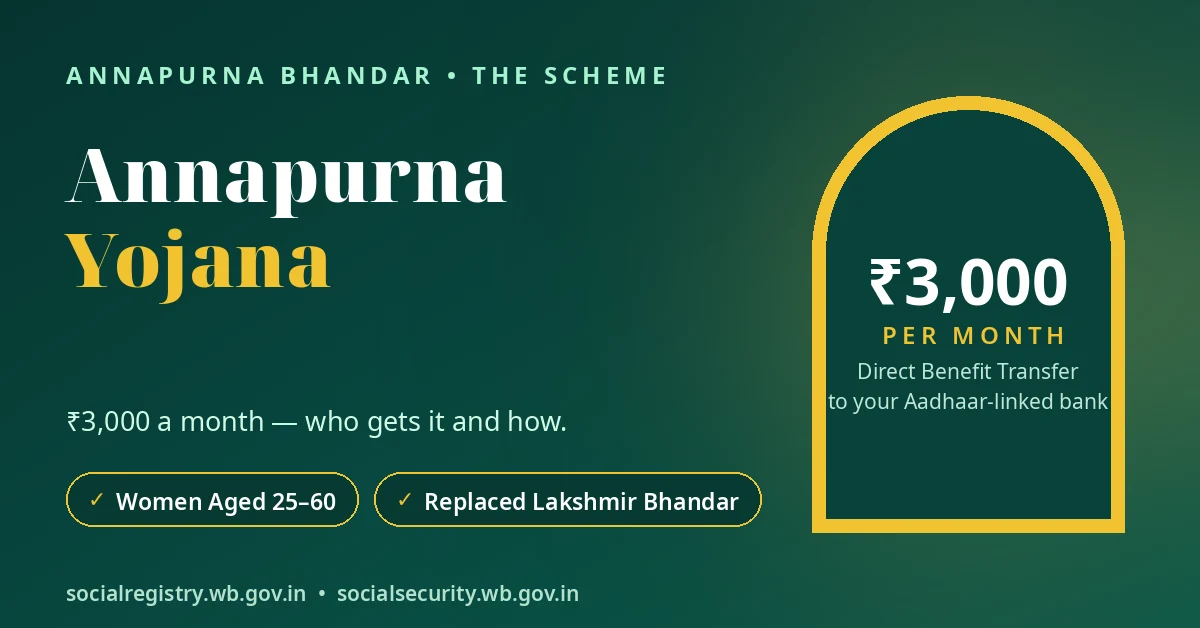
Annapurna yojana is West Bengal’s monthly cash assistance scheme for women. It provides ₹3,000 every month through Direct Benefit Transfer (DBT) into the beneficiary’s own Aadhaar-linked bank account. Its official name is Annapurna Yojana, while people commonly call it “Annapurna Bhandar”, the campaign name.
The scheme replaced Lakshmir Bhandar on 1 June 2026. It also increased the monthly assistance from ₹1,000–₹1,200 to a flat ₹3,000. Here, you can learn who qualifies, which documents you need, how the government processes applications and what happened to existing Lakshmir Bhandar beneficiaries.
Quick Answer
Annapurna Yojana gives ₹3,000 per month to women aged 25–60 who live in West Bengal. The government sends the money directly to the beneficiary’s Aadhaar-linked bank account.
The government created the scheme through a notification dated 19 May 2026. It took effect on 1 June 2026, and the government launched payments on 3 June 2026.
Annapurna Yojana replaced Lakshmir Bhandar. You need only three mandatory documents: EPIC (voter card), Aadhaar and an active mobile number.
What Is Annapurna Yojana?
The Department of Women & Child Development and Social Welfare (WCDSW), Government of West Bengal, created Annapurna Yojana through Notification No. 2411-WCD/O/AB-4/2026, dated 19 May 2026.
The benefit took effect on 1 June 2026. The government launched payments on 3 June 2026. Phase 1 paid 28,25,769 women ₹3,000 each.
Reports describe “Annapurna Bhandar” as a BJP election-manifesto promise to replace Lakshmir Bhandar with ₹3,000 per month. The new government directed the rollout from June at its first cabinet meeting on 11 May 2026.
The scheme has already reached a large number of women. About 1.45 crore women received payments in August 2026. About 1.58 crore women received the instalment on 17 September 2026, according to a state announcement.
Who Gets It — The Official Eligibility
The official notification lists five clear conditions. You must meet each one before the government can approve your application.
| Criterion | Official requirement |
|---|---|
| Who can apply | A female resident of West Bengal. |
| Age on the date of application | 25 to 60 years. |
| Permanent government employment | No regular salary or pension from the union or state government, statutory bodies, undertakings, panchayat, municipal or local bodies, or government-aided teaching or non-teaching posts. |
| Income tax | You must not pay income tax. |
| Illegal immigrants | They are not entitled to the scheme. |
Does your family income decide eligibility?
No. The SOP says, “poorest of the poor are the first priority”. This is only a priority line for processing. It is not an income ceiling. No official document sets a family income limit for this scheme. Any website that quotes one has invented it. You can read the full requirements in the Annapurna Yojana eligibility and documents guide.
How Much You Get — and How the Money Reaches You
Every beneficiary receives a flat ₹3,000 per month.
| Scheme | Monthly amount |
|---|---|
| Lakshmir Bhandar (old) | ₹1,000–₹1,200 per month (plus ₹500 from February 2026) |
| Annapurna Yojana (from 1 June 2026) | ₹3,000 per month |
How does the government send the money?
The government sends the money through Direct Benefit Transfer (DBT). It goes directly into the Aadhaar-linked bank account in the beneficiary’s own name.
When does the ₹3,000 arrive?
The government has published no fixed monthly payday. Reported credit rounds landed on 3 June, 17 August, 17 September and from 15 October 2026. Because of this, nobody can honestly promise you a fixed payment date each month.
How can you confirm a payment?
You can confirm any credit from your bank passbook, statement or SMS. No portal shows a payment history for the scheme. The Annapurna Bhandar payment status guide explains this check in detail.
Documents — Only Three Are Mandatory
You need only three mandatory documents. The official scheme page on wb.gov.in, the notification and the SOP all agree on this list:
- EPIC (voter card)
- Aadhaar
- An active mobile number
Is a ration card compulsory?
No. The Family Level Data Collection form also asks for ration-card information. That makes a ration card only a form field, not a mandatory document and not an eligibility condition. No official document says you need a specific ration-card type.
How the Scheme Runs — From Application to Sanction
An application follows a clear government process before the money reaches the beneficiary.
Step 1: Application enquiry
Authorised officials enquire into every application.
Step 2: Recommendation by the BDO or SDO
The Block Development Officer (BDO) recommends the eligible list online in rural areas. The Sub-Divisional Officer (SDO) performs the same task in urban areas.
Step 3: Sanction by the District Magistrate or KMC Commissioner
The District Magistrate sanctions the list. In the Kolkata/KMC area, the KMC Commissioner sanctions the list.
Step 4: Upload of sanctioned reports
Officials upload the sanctioned reports to the Annapurna Yojana portal.
Applications and family records live in the Social Registry system. The application status appears on the two official portals. The Annapurna Bhandar portal guide explains both portals and their uses. If you have not applied yet, you can start by reading the Annapurna Bhandar application guide.
How It Replaced Lakshmir Bhandar
From 1 June 2026, Annapurna Yojana replaced Lakshmir Bhandar. Existing Lakshmir Bhandar beneficiaries migrated to Annapurna Yojana automatically. They did not need a fresh application.
Who did not move automatically?
The migration excluded some categories identified during SIR-2026. These included dead, shifted, deleted and absentee electors, deletions in the second list after the draft list, deletions after adjudication, and ASDD cases found during voter-slip distribution.
What about SIR Tribunal appeals and CAA applications?
People who filed SIR Tribunal appeals keep receiving assistance until their case is decided. The same protection applies to people who filed CAA applications.
The Lakshmir Bhandar migration and SIR-2026 guide explains who stays out and what each person can do next.
Five Myths About Annapurna Yojana
Many blogs and social-media posts spread wrong claims about the scheme. Use only the official facts below.
- Myth: “Your family income must be below ₹10,000 a month.” — Fact: no official document sets an income ceiling. The official notification lists the real criteria; income is not one of them.
- Myth: “Women aged 21–60 can apply.” — Fact: the official age on the date of application is 25–60. The 21–60 figure is a ranking page’s error.
- Myth: “You need a specific ration card (AAY/PHH/SPHH/RKSY).” — Fact: no official document requires any ration-card type. Ration-card information is only a field in the data-collection form.
- Myth: “At 60 you automatically move to an old-age pension.” — Fact: no official document says this. Annapurna simply covers ages 25–60.
- Myth: “There is an official Annapurna app to apply or check status.” — Fact: no official source mentions any app. Fake links circulated even before the portal launched (Telegraph, 25 May 2026) and police warned against mirror sites — use only the official portals; report cyber fraud on 1930.
Not This Scheme — Two Names That Confuse People
Two other schemes have similar names, but they are not Annapurna Yojana.
| Name | What it actually is |
|---|---|
| Central “Annapurna Scheme” (2000) | A central government scheme under NSAP for destitute senior citizens aged 65+ who receive no old-age pension. It provides 10 kg of free foodgrains per month. It gives no cash, does not serve women aged 25–60, and West Bengal does not run it. |
| Khadya Sathi | West Bengal’s food and PDS scheme under the Food & Supplies Department. It provides subsidised rice and wheat through digital ration cards. Annapurna Yojana gives cash, not foodgrain. |
বাংলায় সংক্ষেপে
Annapurna Yojana পশ্চিমবঙ্গের মহিলাদের জন্য মাসিক ₹৩,০০০ টাকার সরকারি প্রকল্প। মানুষ একে প্রচলিতভাবে “Annapurna Bhandar” বলে।
এই প্রকল্পে বয়স ২৫–৬০ বছর। টাকা DBT-এর মাধ্যমে নিজের Aadhaar-linked ব্যাংক অ্যাকাউন্টে আসে।
১ জুন ২০২৬ থেকে এই প্রকল্প Lakshmir Bhandar-এর জায়গা নিয়েছে। পুরনো উপভোক্তারা নিজে থেকে Annapurna Yojana-তে চলে এসেছেন, তবে SIR-2026-এ বাদ পড়া কয়েকটি শ্রেণি এর বাইরে রয়েছে।
এখানে বাধ্যতামূলক নথি মাত্র তিনটি: EPIC, Aadhaar এবং একটি চালু মোবাইল নম্বর। Ration card বাধ্যতামূলক নয়।
টাকা পাওয়ার নির্দিষ্ট কোনো তারিখ নেই। টাকা এসেছে কি না, তা ব্যাংক পাসবুক, স্টেটমেন্ট বা SMS দেখে জানা যায়।
Conclusion
Annapurna Yojana offers one scheme, one amount and one bank account. Every eligible woman aged 25–60 receives ₹3,000 every month by DBT.
The rules are simpler than many blogs suggest. You need only three documents, and old Lakshmir Bhandar beneficiaries mostly moved to Annapurna automatically. The Annapurna application status-check guide helps you find the correct route.
Disclaimer: This website is an independent information guide. It is not a government website, and it has no link to the Government of West Bengal. We cannot enrol you, approve your application or release payments. We do not collect your personal details. Use only official government portals and offices for every action.
FAQs
What is Annapurna Yojana?
Annapurna Yojana is West Bengal’s monthly cash assistance scheme for women. Its official name is Annapurna Yojana, while people also call it “Annapurna Bhandar”. It pays ₹3,000 every month by DBT to women aged 25–60.
How much money does Annapurna Yojana give per month?
It gives ₹3,000 every month to each beneficiary. The amount is the same for every eligible woman.
Who can get Annapurna Yojana?
A female resident of West Bengal aged 25–60 can receive the benefit. She must not pay income tax, and she must not hold permanent government employment.
Which documents are mandatory for Annapurna Yojana?
You need only three mandatory documents: EPIC (voter card), Aadhaar and an active mobile number. No other document is mandatory.
Is there an income limit for Annapurna Yojana?
No. The scheme has no official family income limit. The SOP only says that the “poorest of the poor are the first priority”, and this is a priority line for processing.
What happened to Lakshmir Bhandar beneficiaries?
Most existing Lakshmir Bhandar beneficiaries moved to Annapurna Yojana automatically. They did not need a fresh application. Some categories identified during SIR-2026 stayed out of the automatic migration.
When does the ₹3,000 come every month?
The government has set no fixed monthly payday. Reported credits reached beneficiaries on 3 June, 17 August and 17 September 2026, and further credits came from 15 October 2026. You should check your bank passbook, statement or SMS for each credit.
Is Annapurna Yojana the same as the central Annapurna scheme?
No. The central Annapurna scheme is different. It serves destitute senior citizens aged 65+ who receive no old-age pension. It gives 10 kg of free foodgrains per month, not cash.
Is a ration card compulsory for Annapurna Yojana?
No. A ration card is not compulsory. The data-collection form only asks for ration-card information, while the mandatory list includes only EPIC, Aadhaar and an active mobile number.
Scheme details last checked: 10 November 2026.